09 430 3406
 administrator@tiaho.org.nz
I’ve always been just a little bit vain.
I Grew up having cerebral palsy which is a very visible disability. Iin mid teens I decided to accentuate the positive by making the most of my good looks
I went for a flamboyant post punk style which had varying degrees of success, to my mind anyway.
Black on black apparel, big quiffs, eyeliner. If people were going to stare, I wanted to flaunt it.
Growing up with cerebral palsy meant I learnt early that appearance wasn’t simply vanity. It was about reclaiming the first impression. If people were going to notice my disability before they noticed me, I wanted to stack the odds in my favour. Looking avant-garde and cool was one small thing I could control.
Fast forward a few decades and my latest fashion accessory isn’t something from a new wave resurgence. It’s permanently a watering eye accompanied by enough gunk to qualify as a biological hazard.
Apparently I have dry eye syndrome.
Now, if you’ve never had dry eye syndrome, you’ll be forgiven for thinking your eyes or in my case eye simply become…well…dry.
Not at all.
My eye has reacted by producing enough tears to irrigate Northland while manufacturing enough discharge that has me looking like I’ve just crawled out of a low-budget zombie film.
By mid-afternoon I resemble Robert Muldoon after a three-day Cabinet crisis—puffy-eyed, exhausted and looking like I’ve seen things no human should witness.
Every morning begins with a ritual of warm compresses, eyelid scrubs, eye drops and carefully excavating whatever mysterious overnight deposits have accumulated. It’s less a grooming routine and more a conservation project.
The cruel irony is that my dry eye is rapidly making me look even older.
Gravity, never one to miss an opportunity, has decided to join the party.
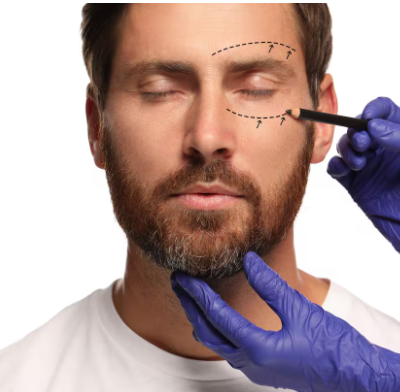
My retired GP brother casually suggested I might be able to have a lower blepharoplasty through my surgical insurance.
Now there was a sentence I hadn’t expected to hear.
An eye lift? Through insurance?
Suddenly I was picturing myself emerging from surgery looking refreshed, youthful and only mildly surprised all the time.
There was, I reasoned, a legitimate medical angle. My lower eyelid bags, or more accurately, the prolapsed orbital fat that accompanies ageing, seemed heavy enough to be encouraging my lower lids southwards. My mother eventually developed ectropion, where the lower eyelid turns outward, and I thought perhaps I was heading down the same path.
Armed with optimism and $370, I booked an appointment with an eye surgeon.
I explained my carefully researched theory.
He wasn’t buying it.
Not even slightly.
The consultation lasted long enough for him to expertly dismantle my hopes before explaining that surgery wasn’t indicated, my eyelids weren’t the problem, and my dry eye certainly wasn’t going to be solved by giving me the Hollywood treatment.
In hindsight, the only thing that underwent surgery that day was my wallet.
Three hundred and seventy dollars disappeared down what can only be described as a surgical drainpipe.
I left looking exactly as I’d arrived except poorer.
Perhaps that’s why this ridiculous, constantly watering eye has annoyed me more than it should. It’s not really about wrinkles or eye bags. It’s about losing another little piece of control over how the world sees you.
It strikes me that this is exactly why so many disabled people are watching the Government’s proposed Disability Support Services legislation so closely. On paper it’s about funding, eligibility and assessment. In reality it’s about something much more personal: who gets to decide how disabled people live their lives. Most of us have spent a lifetime adapting, compromising and finding ingenious workarounds. What we value isn’t perfection. It’s agency. The Bill gives any future Ministers of Disability broad powers to determine not only eligibility, but also the programmes, rules and conditions under which disability support is provided. That’s why many disabled people are concerned about this legislation, because so much of what enables us to live independent lives could increasingly depend on decisions made for us rather than with us.
Which brings me to my latest adaptation. I’ve invested in a pair of lightly blue-tinted Simon Cowell-style sunglasses. They’re subtle enough to wear indoors and even at night, and they perform the minor miracle of concealing the bloodshot eyes, constant watering and assorted visual mayhem that dry eye syndrome leaves behind.
Like so many adaptations disabled people make, they’re not about pretending the disability isn’t there. They’re about restoring a little confidence and a little control. We spend our lives finding practical ways to navigate a world that wasn’t designed with us in mind. Sometimes that’s sophisticated assistive technology. Sometimes it’s changing how you work. And sometimes it’s simply a pair of lightly tinted sunglasses that let you face the world without looking like you’ve just staggered out of a zombie apocalypse.
The eye surgeon may have declined to turn back the clock, but I’ve discovered something better. Disabled people have always been remarkably good at adapting. It’s a skill we’ve been forced to perfect. I just never imagined my latest assistive device would come from the sunglasses rack.
This article was published in the Northern Advocate on July 4th, 2026.